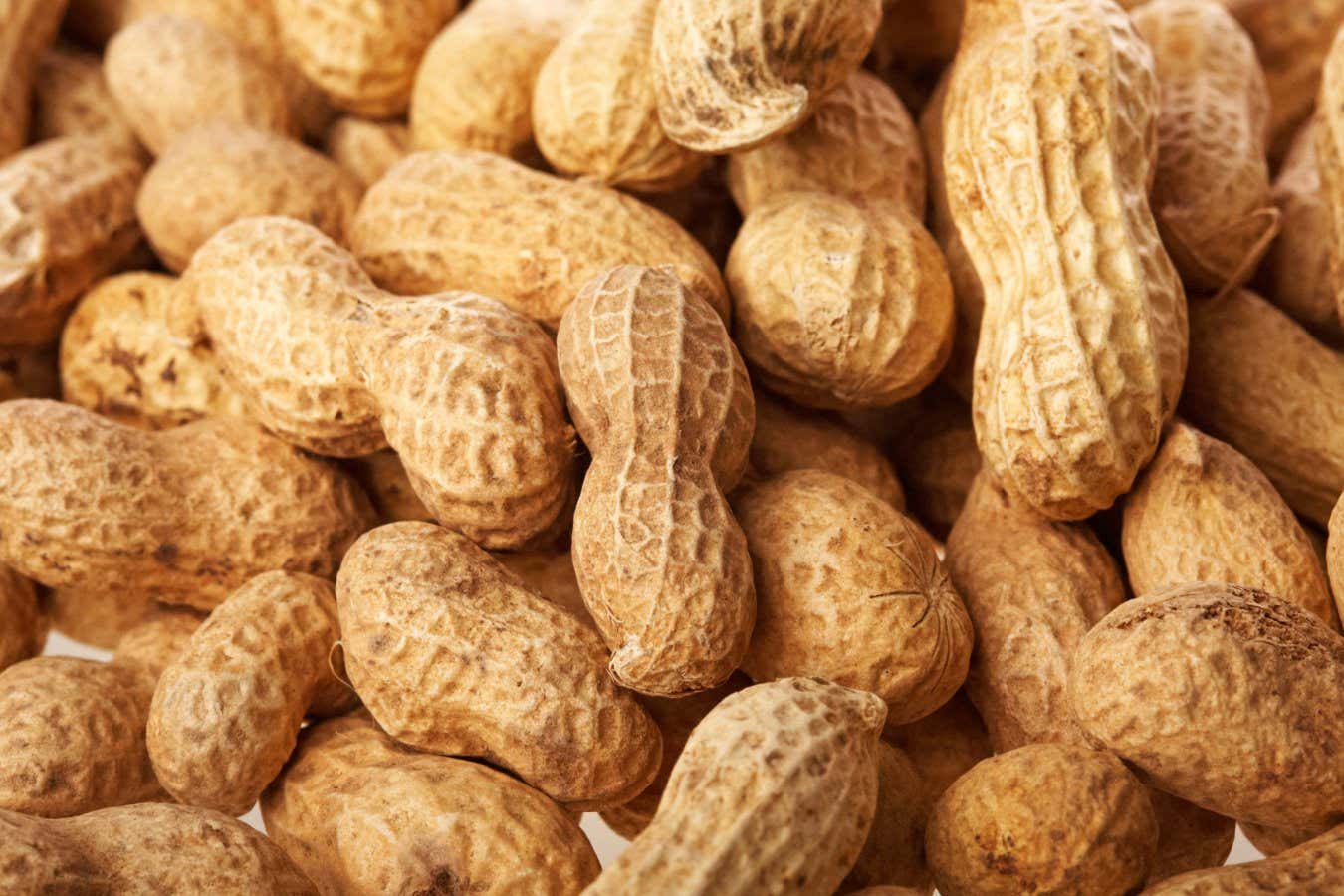
Peanuts are one of the most common food allergens
Radharc Images / Alamy
The microbiomes in our gut and mouth may determine whether people with a peanut allergy develop a life-threatening reaction. This could help explain why some people with the allergy experience relatively mild reactions, while others develop severe, or even fatal, symptoms.
“There’s a big question around why some patients are more susceptible to more severe reactions,” says Rodrigo Jiménez-Saiz at the Autonomous University of Madrid in Spain.
Peanut allergy occurs when the immune system mistakenly identifies proteins in the legume as a threat, causing it to produce excessive amounts of a particular type of antibody. This ramps up inflammation, leading to symptoms such as itching, swelling and vomiting. In extreme cases, peanut exposure causes anaphylaxis, a life-threatening reaction that typically involves breathing difficulties.
Jiménez-Saiz and his colleagues wondered whether the microbes that live on and within us play a role here, given the huge influence that our body’s various microbiomes have on our immune system.
To find out, they inserted a small amount of peanut into the stomachs of three groups of mice without any allergies. The first group was reared to develop no microbiome (known as germ-free mice), while the second had a minimally diverse microbiome, and the third had a microbiome that is typical of a healthy mouse.
Forty minutes later, the team found higher levels of two proteins that play a major role in peanut allergy, known as Ara h 1 and Ara h 2, in the small intestines of the germ-free and minimal-microbiome mice than in those with the most diverse microbiome.
Further analyses revealed that the latter group carried the highest levels of a group of bacteria called Rothia, especially the strain Rothia R3, which is involved in digesting and degrading peanuts in the gut.
To explore whether Rothia R3 influences anaphylaxis risk, the researchers induced severe peanut allergies in a separate group of mice, which had a minimally diverse microbiome.
They then implanted Rothia R3 into some of their guts, before delivering peanut paste directly into all of the animals’ stomachs. Forty minutes later, all the mice had developed anaphylaxis, but the body temperature of those that received Rothia R3 had dropped by just 2 per cent, on average, compared with 3.5 per cent for the mice that didn’t receive it. Anaphylaxis typically causes a drop in body temperature, which can lead to hypothermia and organ failure.
The Rothia-implanted mice also had about half the levels of an immune molecule called MMCP-1 in their blood, which usually rises during anaphylaxis, compared to the control mice. “The findings are compelling,” says Mohamed Shamji at Imperial College London. “If a similar immunological change occurred in people, you would expect this to reduce the severity of anaphylaxis symptoms.”
In another experiment involving 19 people with peanut allergies, the team found that those with a greater tolerance of peanuts had substantially higher levels of Rothia bacteria in their saliva than those with more severe allergies. This suggests that the presence of these bacteria in people’s mouths, as well as in their gut, influences their anaphylaxis risk.
Rothia probiotics could one day reduce the severity of anaphylaxis developing during a peanut allergy reaction, says Shamji. “The need for something like this is huge,” he says. It could particularly alleviate fear around accidental exposure to peanuts and reduce the risk of adverse reactions during oral immunotherapy, which aims to treat allergies by gradually exposing people to increasing doses of an allergen, he says.
The team hopes to demonstrate the potential of such a treatment in a clinical trial by giving people with peanut allergies either Rothia probiotics or a placebo, before exposing them to low levels of peanuts, says Jiménez-Saiz.
Topics:
About the Author