Capricorn season unfolds at the darkest and coldest point of the year, spanning roughly from December 21 to January 21. Astronomically, it begins at the winter solstice, when the Sun enters 0° Capricorn and reaches its lowest position in the Northern Hemisphere sky. In extreme northern regions such as Tromsø, Norway, the Sun does not rise at all between November and January, making this season a profound encounter with darkness, stillness, and endurance. Yet it is precisely within this darkness that the Capricorn season teaches its most essential lesson: structure, faith, and long-term resilience are born when conditions are at their harshest.
Capricorn Season Spiritual Meaning
This period coincides with some of the most spiritually layered celebrations of the year. The pagan festival of Yule begins at the winter solstice and traditionally lasts until January 1, marking the rebirth of the Sun as daylight slowly begins to return. Christianity later placed the birth of Jesus Christ within this same liminal window, and Christmas celebrations continue through January 6 with Epiphany, commemorating the arrival of the Three Kings. According to Christian tradition, the Magi—astrologers by another name—were guided by a star from the East. Many scholars believe this “star” may have been a rare and brilliant conjunction of Venus and Jupiter, blending celestial symbolism with spiritual revelation.
Winter Solstice & Epiphany
Capricorn season is, therefore, a time when ancient pagan cosmology and Christian theology echo one another. In pagan belief, the Sun is reborn at the solstice; in Christianity, Christ is born as the light of the world. Both narratives center on hope returning in the midst of darkness. As the days begin to lengthen after December 21, the gradual ascent of the Sun mirrors themes of renewal, salvation, and divine order—core Capricorn ideals rooted in patience, discipline, and faith in a future not yet visible.
Gifts & Evergreen Trees
Many winter traditions we now associate with Christmas have their roots in Yule customs. Evergreen trees, wreaths, and pine branches symbolize life that persists even in deathlike conditions. Decorating a tree was once an outdoor ritual, with celestial ornaments honoring ancestors and the continuity of the soul. Evergreen wreaths placed on doorways were believed to protect the household and invite prosperity—an idea later absorbed into Christian symbolism of eternal life through Christ. The burning of the Yule log over the twelve days of Yule marked the passing of time and the safeguarding of the home, a practice that survives today in symbolic forms, from candles to festive desserts.
Gift-giving also predates Christianity, originating as a humble exchange of natural or handmade items meant to strengthen community bonds. Christianity later reframed this act through the gifts of the Magi—gold, frankincense, and myrrh—transforming a pagan gesture of reciprocity into a sacred reminder of generosity and devotion.
The Yule Goat & Santa
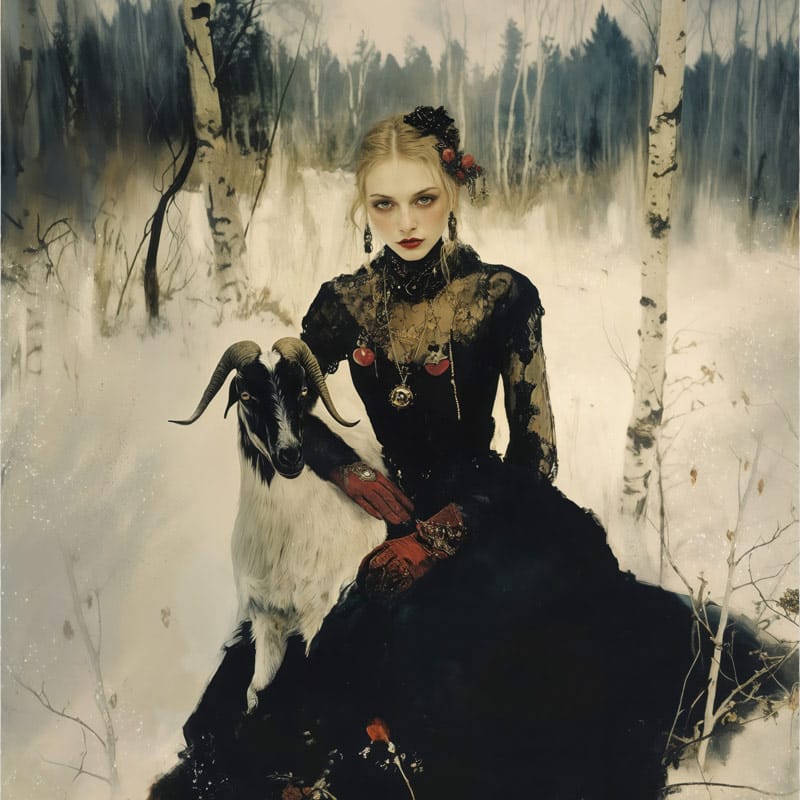
Capricorn’s symbolism is further reflected in the Yule goat, a powerful figure in Nordic tradition. The goat, associated with Thor and fertility, later became a guardian spirit overseeing Yule preparations. In Sweden, the Yule goat was said to deliver gifts and test whether families honored tradition properly, a role that gradually evolved into the modern figure of Santa Claus. The goat’s connection to Capricorn—the sea-goat zodiac sign—makes it an especially potent emblem of this season’s blend of responsibility, ritual, and myth.
Sacred plants play a central role in both pagan and Christian winter symbolism. Mistletoe was revered by the Druids as a magical plant that existed between worlds, growing neither fully in the earth nor entirely in the sky. Its white berries were associated with life-giving force and fertility, giving rise to the tradition of kissing beneath it. Holly, with its sharp leaves and red berries, was believed to ward off evil and protect newborns. In Christian symbolism, holly’s red berries came to represent the blood of Christ, while its evergreen nature signified eternal life. Ivy, winding in spirals around trees, symbolized resurrection and immortality, reinforcing the shared pagan and Christian themes of rebirth and continuity.
Christmas Colours
The familiar Christmas colors also reflect this fusion of belief systems. Red and green dominated medieval church art and religious screens long before they became commercial holiday staples. Red represents both the blood of Christ and the life force seen in holly berries and poinsettias—the only vivid colors visible in winter’s barrenness. Green symbolizes enduring life, prosperity, and spiritual renewal through evergreen plants and the promise of Christ’s eternal presence. Gold honors the returning Sun, divine light, and one of the Magi’s gifts, embodying abundance and sacred kingship. White reflects snow, purity, and the triumph of light over darkness, a symbol shared across pagan and Christian traditions as a sign of hope and moral renewal.
Janus & Crossroads
As Capricorn season progresses into January, the influence of the Roman god Janus becomes relevant. January is named after Janus, the two-faced deity of beginnings, endings, gates, and transitions. One face looks to the past, the other to the future, perfectly capturing the reflective nature of this time of year. Janus presided over thresholds both literal and symbolic, reminding us that Capricorn season is not only about endurance but also about conscious planning, accountability, and intention-setting for the year ahead. His image on Roman coins reinforced the idea of order, civilization, and measured progress—qualities deeply aligned with Capricorn’s archetype.
Ultimately, Capricorn season is a sacred crossroads where astronomy, mythology, and spirituality converge. Whether through Yule, Christmas, or the quiet resolve of winter itself, this season invites us to honor tradition, reflect on what has been built and what must be released, and place our faith—like the rising Sun—in the slow but certain return of light.
About the Author