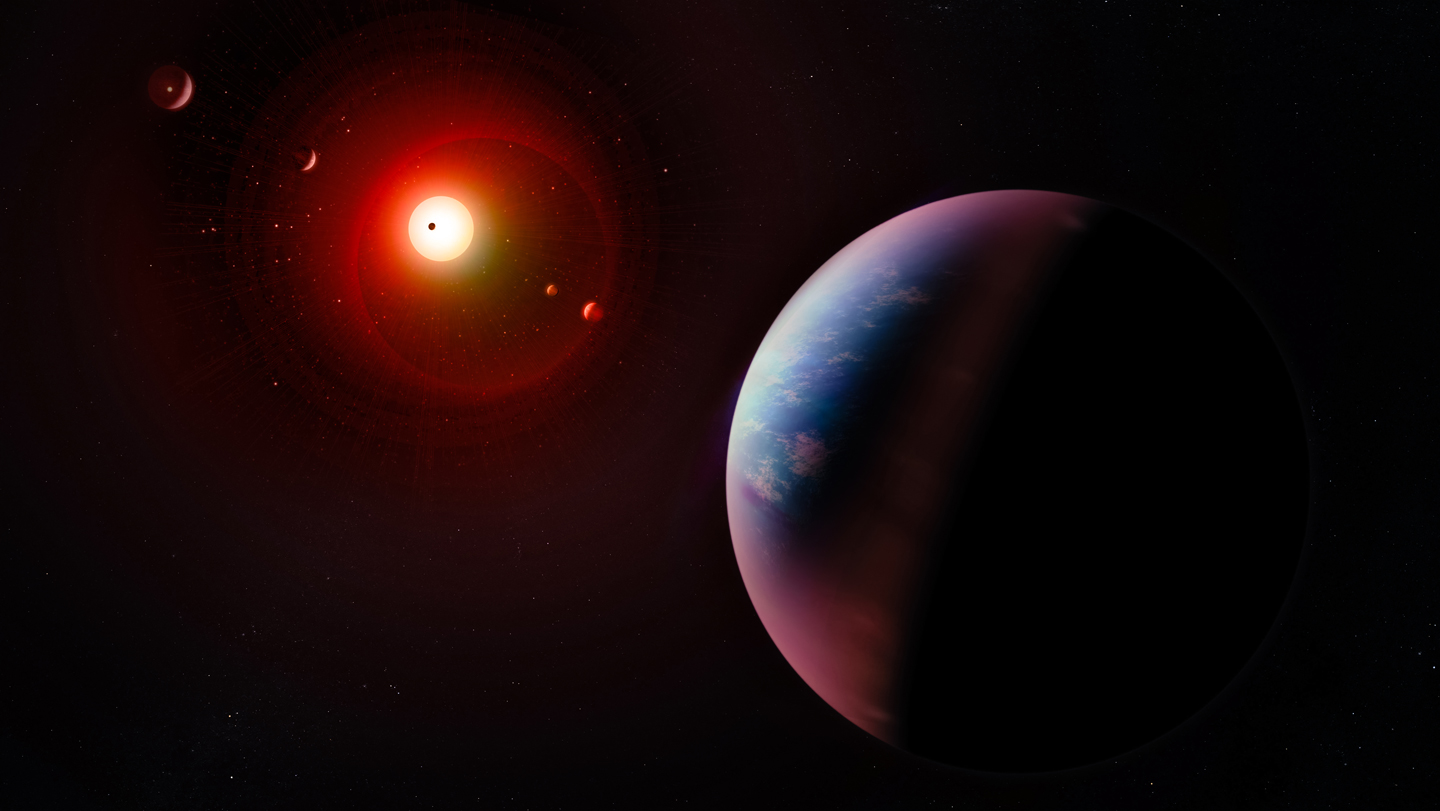
Astronomers’ favorite fable just got a new twist. The “Goldilocks zone” — the region of space not too close and not too far from a star where liquid water could exist on a planet’s surface — now has a chemical equivalent. Researchers have found that a narrow range of planetary conditions are necessary to ensure the availability of bioessential nutrients like phosphorus and nitrogen.
The team simulated tens of thousands of exoplanets and found that fewer than 1 in 10 had Earthlike abundances of phosphorus and nitrogen. The results might help explain why life hasn’t yet been found beyond our home planet, planetary scientist Craig Walton and colleagues report February 9 in Nature Astronomy.
Water is important for planetary habitability, but it’s not everything, says Walton, of the University of Cambridge. “You need nutrients.” In particular, elements such as phosphorus and nitrogen are crucial to assembling cell walls, encoding genetic information and building proteins, among other roles. Imagining life without these nutrients is a stretch, Walton says. “It’s really hard to come up with what an alternative biology would look like.”
But even a watery planet bestowed with phosphorus and nitrogen from its birth environment doesn’t get a scientific green light to host life. That’s because these elements can sink into the core of a forming planet. And unlike a planet’s mantle, which regularly exchanges material with the surface via volcanism, the core is isolated. Any phosphorus or nitrogen that makes its way there is of no use to life living on the surface, says Sebastiaan Krijt, an astrophysicist at the University of Exeter in England, who was not involved in the research. “It’s completely inaccessible to life.”
Whether or not phosphorus and nitrogen sink into the core depends on the availability of reactable oxygen in the mantle. “Oxygen is really what’s key,” says Laura Rogers, an astronomer at NOIRLab in Tucson, Ariz. The oxygen abundance determines how phosphorus and nitrogen react with iron, which tends to sink deeper and deeper into a forming planet over time. When there’s lots of oxygen around, phosphorus doesn’t bind to iron and therefore tends to remain in the mantle; nitrogen, on the other hand, will bind to iron and sink into the core. Low levels of oxygen result in the opposite pattern — less phosphorus in the mantle and more nitrogen.
That’s a push-pull situation, Walton says. “You’re gaining one, you’re losing another.”
Walton, Rogers and their team surmised there must be a “chemical Goldilocks zone” — a sweet spot of oxygen abundance that results in Earthlike quantities of both phosphorus and nitrogen in a planet’s mantle. To investigate that idea, they simulated exoplanets with initial phosphorus and nitrogen quantities based on the observed chemistry of several thousand nearby stars and a range of reactable oxygen levels drawn from prior theoretical work.
Less than 10 percent of those planets had sufficient quantities of both phosphorus and nitrogen in their mantle to support life, the team found. “It looks like there are going to be loads of planets out there that are starved of nitrogen or phosphorus,” Walton says. Reactable oxygen at Earthlike levels or even slightly above ended up providing just the right conditions for retaining life-supporting levels of phosphorus and nitrogen in a planet’s mantle, the team discovered.
Exoplanets are being found all the time; over 6,000 have been confirmed to date. But a lot of planetary parameters have to align in order for life to potentially gain a toehold—in addition to the requirement for liquid water, oxygen availability has be just right, too. “This forces us to reconsider how prevalent Earthlike planets are in the cosmos,” Krijt says.
Physicist Enrico Fermi famously asked where all the extraterrestrial life is. Maybe the Fermi Paradox — the conundrum that the universe is vast and yet life hasn’t been found beyond Earth — makes a bit more sense now.
Source link
About the Author